




Headline: Secretary of War Hegseth Declares U.S. Military “On Offense” Against Narco-Terrorists in Historic Shift
WASHINGTON – In a forceful address to military leaders from across the Americas, Secretary of War Pete Hegseth announced that the United States military is officially “on offense against narco-terrorists” for the “first time in history,” signaling a major escalation in the Trump administration’s approach to hemispheric security.
Speaking at the inaugural Western Hemisphere Chiefs of Defense Conference in Washington, D.C., Hegseth outlined a strategic pivot that moves beyond traditional law enforcement interdiction to direct military engagement. The Secretary confirmed that under President Donald Trump’s directive, the Department of War is now executing lethal kinetic operations to dismantle transnational criminal organizations, which the administration has designated as Foreign Terrorist Organizations (FTOs).
Deep Search: Operations “Southern Spear” and “Absolute Resolve”
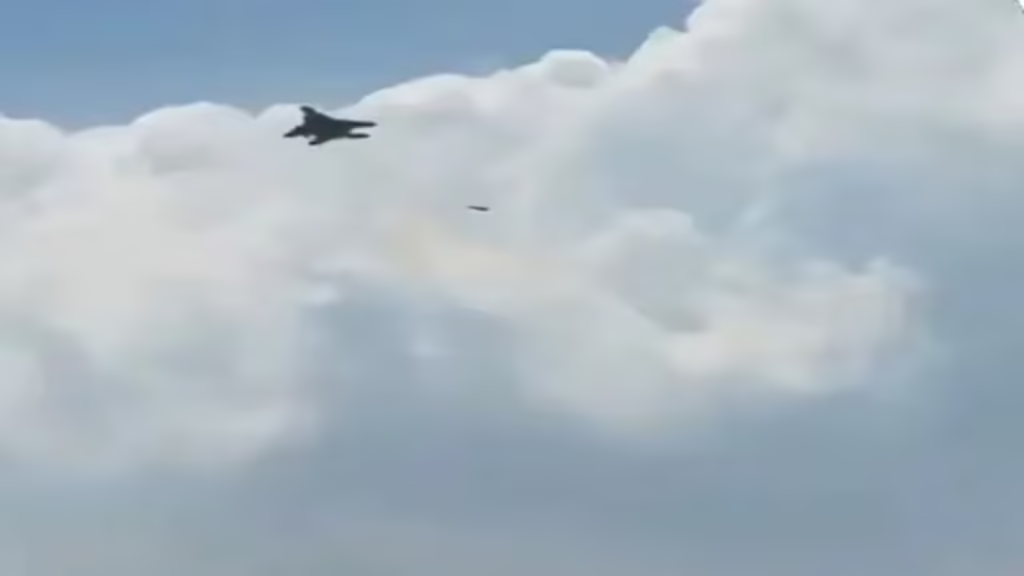
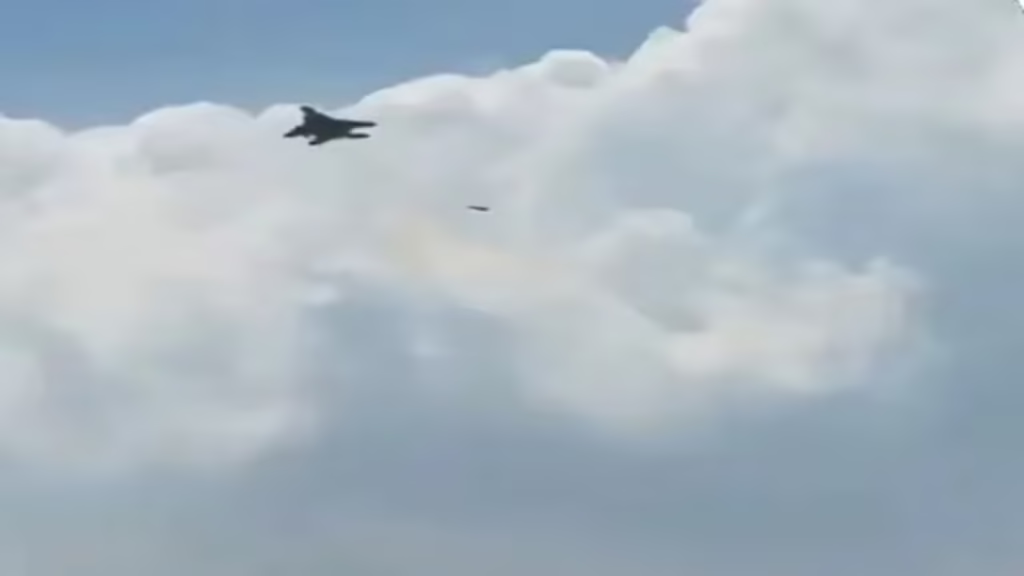
Hegseth detailed the operational scope of this new doctrine, specifically highlighting Operation Southern Spear. Launched by U.S. Southern Command (SOUTHCOM), this campaign authorizes airstrikes and naval engagements against vessels suspected of trafficking illicit narcotics in the Caribbean and Eastern Pacific. Since its commencement in late 2025, the operation has reportedly resulted in the destruction of dozens of “narco-terrorist” vessels.
“We are not mitigating the threat; we are eliminating it,” Hegseth told the assembly of defense chiefs from 34 nations. “Narco-traffickers know that the true cost of flooding our country with deadly drugs is death for themselves—a real deterrent.”
The Secretary also touted the recent success of Operation Absolute Resolve, a high-stakes mission that led to the capture of Venezuelan leader Nicolás Maduro earlier this year. Hegseth cited the operation as proof of the administration’s resolve to enforce the “Trump Corollary” to the Monroe Doctrine, asserting that sovereignty in the Western Hemisphere depends on “military power, not just traditional law enforcement.”
Objections: Legal and Ethical Concerns
The administration’s aggressive stance has drawn sharp criticism from international legal experts and regional governments. Critics argue that treating drug traffickers as enemy combatants rather than criminal suspects bypasses due process and violates international maritime law.
Government officials in Colombia have previously condemned the airstrikes, with some diplomats describing the unilateral actions as “extrajudicial” and a violation of territorial sovereignty. Legal scholars have raised concerns that striking unflagged vessels without an imminent military threat could be construed as “murder on the high seas” under current international statutes. Furthermore, domestic opponents in Congress have questioned the executive branch’s authority to conduct acts of war against non-state criminal groups without explicit congressional authorization.
Background: A Redefined Department of War
This policy marks a significant departure from the “War on Drugs” of previous decades, which relied primarily on the Drug Enforcement Administration (DEA) and Coast Guard law enforcement detachments, with the military playing a supporting role in detection and monitoring.
The rebranding of the Department of Defense back to the “Department of War”—a title not used since 1947—and the designation of cartels as FTOs underscore the administration’s intent to militarize the conflict fully. By invoking the Monroe Doctrine, Hegseth framed the Western Hemisphere as a “homeland defense” priority, equating the flow of fentanyl and narcotics to a direct invasion that requires a military response comparable to counter-terrorism operations in the Middle East.
wikipedia.org
war.gov
wsws.org