








A former South Carolina pastor, now identified as a federal defendant, has been charged with cyberstalking and making false statements in the lead-up to his estranged wife’s death, according to court records. The indictment comes nearly two years after the tragic discovery of the woman’s body in a state park, and details alleged harassment, online abuse and deceptive conduct by the accused husband.
Allegations of Harassment and Cyberstalking
Federal prosecutors allege the defendant engaged in repeated unwanted communications and intrusive behavior toward his estranged wife from late 2022 up until her death in April 2024. According to the charges, these actions included posting explicit images of her online without consent, placing tracking devices on her vehicle, and contacting her relentlessly on certain days — at times as many as 50 times in one day.
The indictment also accuses him of tampering with her personal finances and daily routine, as well as damaging her vehicle’s tires. Authorities contend that these acts, repeated over an extended period, amount to a calculated pattern of cyber harassment and control.
False Statements to Federal Investigators
In addition to the cyberstalking count, the federal indictment includes charges of making false statements to investigators. Prosecutors claim the defendant misled authorities about his conduct, including denying involvement in the vehicle damage and falsely telling federal agents he had hired a private investigator to protect his wife when, prosecutors argue, the investigator was actually engaged to monitor her.
The indictment further states that evidence contradicts claims made by the defendant during interviews, including his version of events regarding contact orders and investigative directives.
Legal Consequences and Next Steps
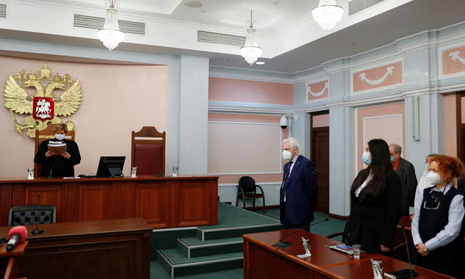
The defendant, 46, is scheduled to appear in federal court in Florence, South Carolina, on Jan. 12, 2026, where he will be formally arraigned on the charges. If convicted, he could face up to five years in prison for the cyberstalking count and an additional two years for the false statements charge, along with possible fines.
The case has drawn significant public interest, reigniting discussions on online harassment, domestic surveillance, and the responsibilities of authorities in domestic abuse cases.