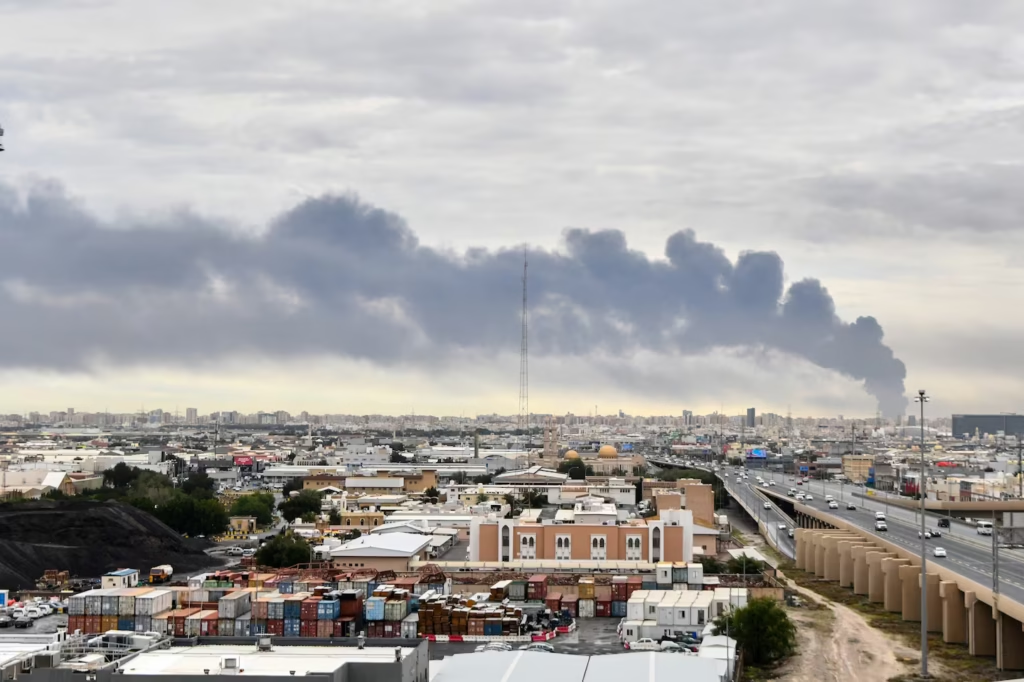









China Asserts Gaza Ceasefire is Prerequisite for Red Sea De-escalation
Beijing has formally articulated its position regarding the deteriorating security situation in the Red Sea, explicitly linking the maritime crisis to the ongoing conflict in the Gaza Strip. In a recent statement, Chinese officials emphasized that the turbulence in Yemen and the crucial shipping lanes of the Red Sea cannot be viewed in isolation, but rather as symptoms of the broader instability engulfing the Middle East.
According to Beijing, the most effective path toward a full de-escalation in the Red Sea is the implementation of an immediate and lasting ceasefire in Gaza. Chinese diplomats have argued that the “spillover effect” of the Israel-Hamas war is the primary driver of regional tension. By positioning the Gaza conflict as the root cause, China is urging the international community to focus diplomatic efforts on stopping the fighting in Palestinian territories as a means to restore order to global shipping routes.
Background of the Crisis
The situation in the Red Sea remains volatile as Yemen’s Houthi rebels continue to launch drone and missile attacks against commercial vessels. The Houthis, an Iran-backed group controlling significant portions of Yemen, have declared that their maritime campaign is an act of solidarity with Palestinians, vowing to target ships linked to Israel and its allies until humanitarian aid reaches Gaza and the bombardment ceases.
This campaign has severely disrupted global trade, forcing major shipping companies to reroute vessels around the Cape of Good Hope, adding weeks to delivery times and driving up costs. In response, the United States and the United Kingdom have launched airstrikes against Houthi infrastructure in Yemen, while deploying a naval coalition to intercept incoming projectiles.
Strategic Divergence and Objections
China’s stance highlights a sharp geopolitical divergence from the approach taken by Washington and its Western allies. While Beijing advocates for addressing the political root—specifically the Palestinian question—Western powers have largely treated the Red Sea attacks as a separate security issue regarding freedom of navigation.
Critics of the Chinese position, particularly in Washington and London, argue that maritime security and freedom of navigation are non-negotiable international rights that should not be held hostage to the conflict in Gaza. From this perspective, the Houthi attacks are viewed as acts of terrorism and piracy that threaten the global economy, independent of the geopolitical status of Gaza. Furthermore, skeptics argue that linking the two issues legitimizes the Houthi narrative and rewards the use of force against civilian shipping. There are also concerns among security analysts that even a ceasefire in Gaza might not guarantee that Houthi leadership would immediately cease operations, as the group may utilize the leverage they have gained over global trade for their own domestic political aims in Yemen.
Despite these objections, China maintains that military interventions in Yemen alone will not yield a sustainable solution. Beijing continues to position itself as a neutral peace broker in the region, warning that without resolving the humanitarian disaster in Gaza, the Middle East remains at risk of an uncontrollable regional conflagration.