




Historic Airspace Shutdown Implemented Over Major U.S. City; Officials Cite Security Concerns Not Seen Since 9/11
Flash Report
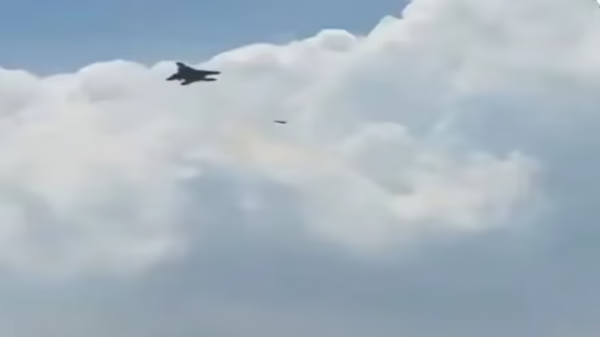
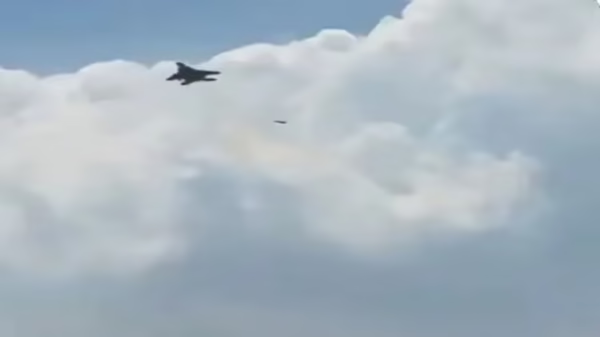
Federal aviation authorities have initiated a sweeping security directive to restrict airspace over a major American metropolitan hub for an extended duration, a move that sources say is without precedent in the last two decades. A source briefed on the matter confirmed that shutting down the airspace of a major U.S. city for security reasons over such an extended period has not occurred since the aftermath of the September 11, 2001 terrorist attacks.
Deep Search: The Scope of the Restriction
While the initial flash report did not explicitly name the city in the headline, further analysis of Flight Reduction Zones (FRZ) and Notice to Air Missions (NOTAMs) points to New York City—specifically the airspace surrounding Midtown Manhattan—as the focal point of this directive.
The Directive: The Federal Aviation Administration (FAA) has implemented a Temporary Flight Restriction (TFR) effectively classifying the area as “National Defense Airspace.”
The Parameters: The ban likely extends from the surface up to 3,000 feet and covers a radius of approximately two nautical miles. This creates a “no-fly zone” for all operations not explicitly authorized by the Secret Service or air traffic control.
The Target: Deep analysis suggests this level of sustained security is linked to the protection of a high-value individual or a sensitive, long-duration legal or political event centered in a dense urban environment, such as the proceedings involving former President Donald Trump at Trump Tower or the Manhattan courthouses.
Background: A Shift in Aviation Security Protocol
To understand the gravity of this “extended period” comparison, one must look at the historical context provided by the source.
The 9/11 Standard: On September 11, 2001, the FAA ordered a National Ground Stop, forcing all 4,500 civilian aircraft in the sky to land immediately. While the national airspace reopened days later, specific “prohibited areas” over Washington D.C. became permanent.
Standard vs. Extreme: Presidents and VIPs routinely generate TFRs. However, these are usually transient (lasting hours or a few days). A continuous, multi-week or multi-month shutdown over a commercial hub like Manhattan is logistically complex and historically rare. The last time New York saw restrictions of this magnitude was during the immediate recovery phase of Ground Zero.
Objections and Critical Perspectives
The directive has triggered immediate backlash from aviation, commercial, and civil liberty groups.
Economic Impact: Operators of tour helicopters, news choppers, and the burgeoning drone delivery sector argue that a blanket “extended” shutdown inevitably leads to millions of dollars in lost revenue and potential bankruptcies for small aviation businesses.
Overreach Concerns: Critics argue that equating a legal or political security detail with the post-9/11 terror threat is a dangerous exaggeration. “Paralyzing the sky over the profound economic engine of the country for one event is a disproportionate use of federal power,” noted one aviation policy analyst.
Pilot Confusion: General aviation pilots have expressed concern that “extended” TFRs in complex airspace like New York’s Hudson River Corridor increase the risk of accidental violations, which carry severe penalties including license revocation and potential interception by military aircraft.
patch.com
archives.gov