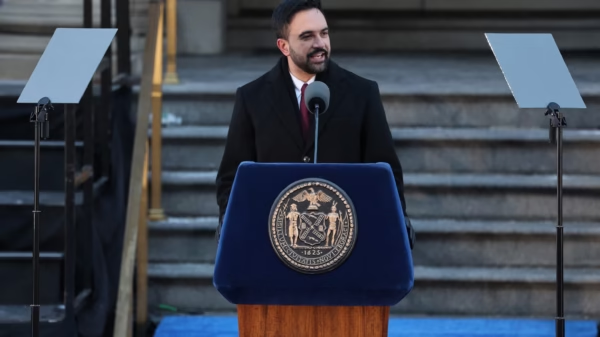
Was it because approaching a lobby tucked between skyscrapers and seeking their approval would be difficult for a Muslim with a Ugandan father and an Indian mother? No one knows. But Mamdani chose to stand only with the people of New York—and with no one else.
“They were in the wrong place at the wrong time. Naturally, they became heroes.”
This line comes from A New Hope, one of the Star Wars films. It came to my mind as Zohran Mamdani—one of the most talked-about figures in America today—burst onto the national stage. Only a few months ago, Mamdani was widely viewed as the last person who could ever become mayor of New York, one of the world’s biggest metropolises and the crown jewel of the United States. New York, the country’s celebrated “capital of capitalism,” home to stock exchanges where companies valued higher than the economies of entire contine
nts are traded, has now elected Mamdani as its mayor.

To millions of Americans, this young man born in 1991 was “in the wrong place.” And to many voters in a country where the far right is rising and the MAGA ethos enjoys deep support, someone who calls himself a “democratic socialist” seemed to be appearing at the “wrong time.” Yet Mamdani, who walked onto the political stage at the “wrong place and wrong time,” ended up winning more than 50 percent of the vote. In his victory speech, he quoted Nelson Mandela—“It always seems impossible until it’s done”—to explain how he had, in a sense, “naturally become a hero.”
How Should We Understand Zohran Mamdani’s Victory?
Mamdani’s triumph can be interpreted along three main axes: his social base, the elite backlash, and his political message. But first let’s acknowledge this: although the result is widely seen as halting—perhaps even reversing—the Democratic Party’s recent “ground slippage,” Mamdani did not receive the level of support he needed from the party’s top figures. Because of his identity, his background, and his distance from political lobbies, most Democratic leaders kept him at arm’s length. With the exception of Bernie Sanders, few prominent Democrats initially offered public support. Even after Mamdani defeated the legendary former governor Andrew Cuomo in the primaries and secured the nomination, party leaders remained largely silent—until the day before the election, when former President Obama finally called him.
And yet, Mamdani never really needed them. He had already gained momentum in the streets—among young people, renters, and precarious workers—by offering a fresh political narrative that reconnected them with civic life. In this metropolis, politics does not only remind people who they are; it also reminds them what they can achieve together. Mamdani forged a genuine connection with Generation Z. His story—meeting his wife on a dating app—may sound like light “celebrity trivia,” but it points to a deeper sociological truth: in today’s digital-local public sphere, politics is no longer driven solely by ideological packages handed down from above. Digital identities and decentralized cyber-communities speak louder than ever.
Young voters recognized someone who shared parts of their own experience—someone who promised practical solutions to everyday survival: transportation, rent, wages, caregiving. They rewarded a politician who prioritized the issues that shape their lives rather than rigid ideological schematics.
The “Establishment’s” Discomfort
Maybe it really is harder for a Muslim whose parents come from Uganda and India to approach lobbyists nestled between skyscrapers and ask for permission. Whatever the reason, Mamdani sought approval only from New Yorkers. He spoke boldly, kept his distance from lobbying groups, and naturally his platform grew into something bigger. Being personally targeted by President Trump—who himself constantly rails against “the establishment”—only made him more popular.
Lined up against him were Cuomo, Wall Street, lobbying firms, Elon Musk, and massive media empires. While their discomfort with Mamdani was not explicitly about his Muslim or Indian background, their full-scale opposition revealed something else: they feared his unapologetically socialist policies.
What Comes Next?
Mamdani cannot become president because he was not born in the United States. But as someone who does not hide his identity, and who remains aligned with America’s secular social values, he may use this victory as a city-level “resistance” against the Democratic Party’s increasingly cautious, right-leaning reflexes. In a moment when the party is scattered—shaken by Trump’s sweeping electoral win and his aggressive, rapid-fire executive orders—Mamdani may be the only figure within Democratic circles who appears to know exactly what he is doing.
In the digital age, maintaining popularity is as important as winning it. Mamdani’s election is only the first step. Ahead lie crucial tasks: expanding social infrastructure without breaking the budget, protecting renters while increasing housing supply, delivering free or affordable services efficiently, maintaining balance in supply and demand, creating negotiation channels with unions without destabilizing operations, and—most importantly—developing strategies to survive if Trump fulfills his threat: “If Mamdani wins, I’ll cut the funds.”
If he is to succeed, he has no choice but to govern with resilience against top-down pressure while delivering effective, concrete results to the people below.
Conclusion
Mamdani combined a personal narrative that resonated with Generation Z with a political message unafraid of challenging entrenched lobbies. The fact that the President targeted him directly—recognizing his influence—energized his campaign. While the old New York establishment panicked, voters prioritized the arithmetic of everyday life over identity politics.
If Mamdani can now channel his campaign’s energy into institutions and transform it into tangible achievements, this will be more than a municipal success. It may offer the Democratic Party a roadmap to regain the trust of young Americans it has been steadily losing nationwide.